1. What Makes Quantitative Analysis Advanced?
In Part 1, you learnt how to prepare the titration table, obtain concordant titres and calculate concentration. In Part 2, you will learn how WAEC extends the same titration data into deeper questions.
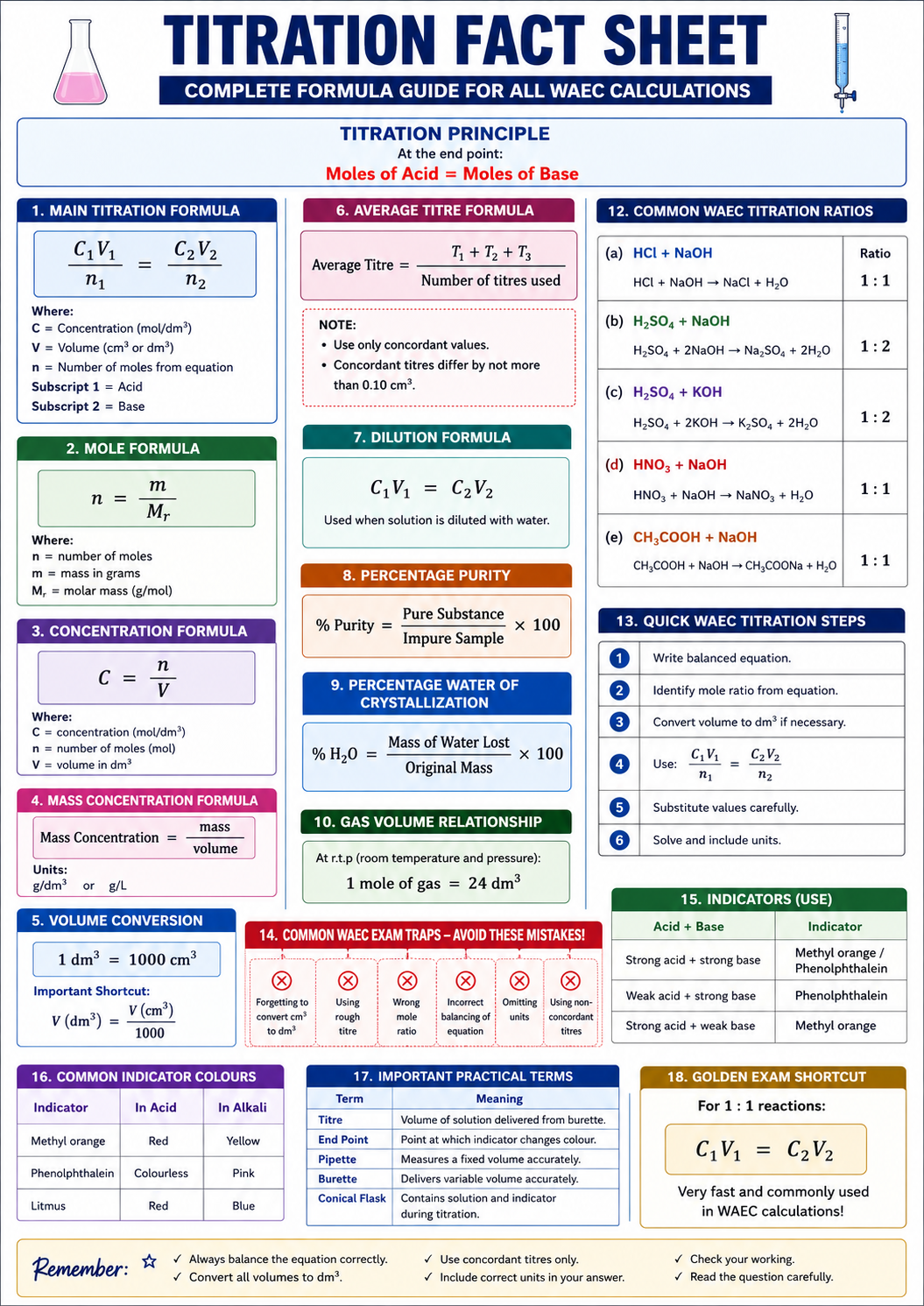
Calculation Extension
WAEC may ask for concentration in mol dm⁻³, g dm⁻³, mass in a given volume, or moles of ions.
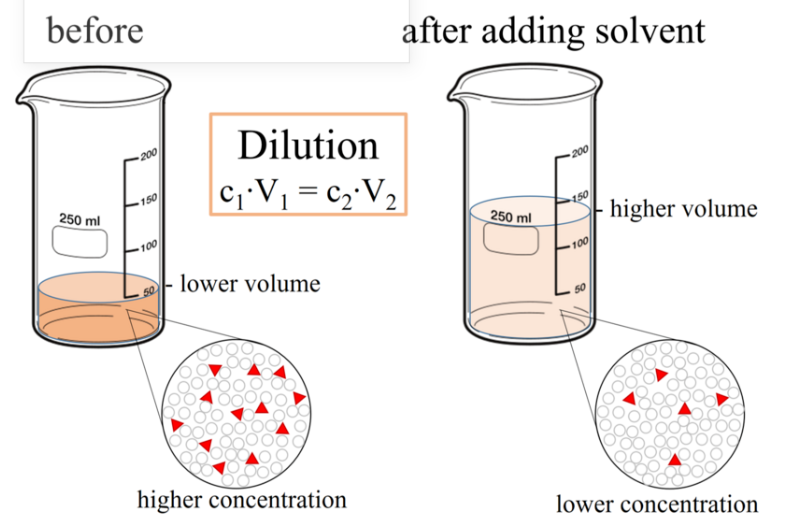
Dilution
You may be asked to prepare a weaker solution from a stronger one using \(C_1V_1=C_2V_2\).
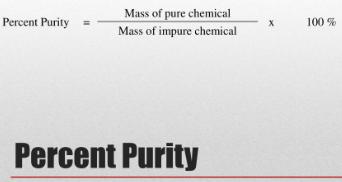
Purity
You may be asked to determine percentage purity of an impure acid, alkali or carbonate sample.
2. Formula Bank for WAEC Quantitative Analysis
| Formula | Meaning | Use |
|---|---|---|
| \(n=CV\) | Moles = concentration × volume in dm³ | Finding amount of reacting substance |
| \(C=\frac{n}{V}\) | Concentration = moles ÷ volume | Finding mol dm⁻³ |
| \(C=\frac{mass\ concentration}{molar\ mass}\) | Convert g dm⁻³ to mol dm⁻³ | When solution strength is given in g dm⁻³ |
| \(C_1V_1=C_2V_2\) | Dilution formula | Preparing diluted solution |
| \(\%\ purity=\frac{pure\ mass}{impure\ mass}\times100\) | Percentage purity | Impure sample questions |
| \(mass=n \times molar\ mass\) | Mass from moles | Mass calculation |
Teacher
Students, the formula is not the beginning. The equation is the beginning. The formula only works correctly when the mole ratio is correctly taken from the balanced equation.
Student
Sir, must I convert cm³ to dm³?
Teacher
Yes, when using \(n=CV\), volume must be in dm³. Since \(1000cm^3=1dm^3\), divide cm³ by 1000.
3. Dilution Calculations
Example
Calculate the volume of \(2.00mol\,dm^{-3}\) HCl required to prepare \(500cm^3\) of \(0.200mol\,dm^{-3}\) HCl.
Teacher
In the laboratory, you measure 50.0 cm³ of the stronger acid and make it up to 500 cm³ in a volumetric flask. You do not simply add 450 cm³ carelessly in any container if precision is required.
Diagram Guide
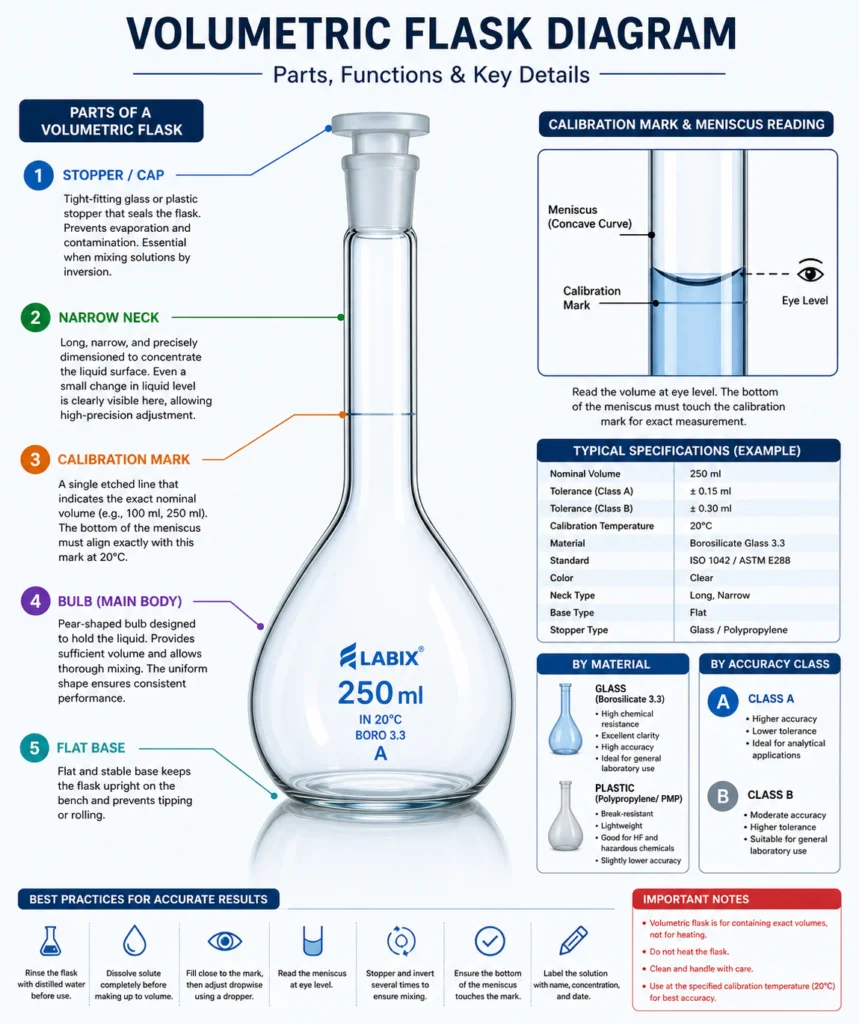 Teacher guide: Label the pipette or measuring cylinder, concentrated solution, volumetric flask, calibration mark and distilled water. The final volume must be made exactly to the mark.
4. Percentage Purity from Titration
WAEC-Style Example
An impure sample of sodium carbonate was dissolved and made up to \(250cm^3\). \(25.0cm^3\) of the solution required \(24.80cm^3\) of \(0.100mol\,dm^{-3}\) HCl. Calculate the mass of pure sodium carbonate in the \(250cm^3\) solution and the percentage purity if the original impure sample weighed \(1.50g\).
Teacher
The most common mistake here is forgetting that only 25.0 cm³ was titrated, while the whole solution is 250 cm³. Since \(250/25=10\), multiply the mass in the aliquot by 10.
Student
Sir, why did we divide HCl moles by 2?
Teacher
Because the equation shows that 2 moles of HCl react with 1 mole of sodium carbonate. The carbonate moles are half the HCl moles.
5. Water of Crystallization
Concept
Some salts contain water molecules in their crystal structure. WAEC may ask you to determine \(x\) in a formula such as \(Na_2CO_3\cdot xH_2O\).
Example
A hydrated sodium carbonate sample has molar mass \(286g\,mol^{-1}\). Find \(x\) in \(Na_2CO_3\cdot xH_2O\).
Teacher
Water of crystallization questions are easy when you separate the salt mass from the water mass. The water part is always divided by 18 because \(H_2O=18\).
6. Full WAEC-Style Quantitative Analysis Task
Question
A is dilute \(H_2SO_4\). B is NaOH solution containing \(4.0g\,dm^{-3}\). \(25.0cm^3\) of B required the following volumes of A:
| Titration | Rough | 1st | 2nd | 3rd |
|---|---|---|---|---|
| Final reading / cm³ | 12.40 | 12.15 | 12.10 | 12.15 |
| Initial reading / cm³ | 0.00 | 0.00 | 0.00 | 0.00 |
| Titre / cm³ | 12.40 | 12.15 | 12.10 | 12.15 |
- Calculate the average titre.
- Calculate concentration of B in \(mol\,dm^{-3}\).
- Calculate concentration of A in \(mol\,dm^{-3}\).
- Calculate mass concentration of A in \(g\,dm^{-3}\).
- Calculate moles of \(H^+\) in the average titre.
- Calculate volume of A needed for \(20.0cm^3\) of B.
WAEC Solution
7. Accuracy, Error Control and WAEC Marking
| Problem | Result | How to Avoid It |
|---|---|---|
| Using rough titre in average | Wrong average | Use only concordant titres |
| Wrong mole ratio | Wrong concentration | Write balanced equation first |
| Not converting cm³ to dm³ | Wrong moles | Divide volume by 1000 |
| Endpoint overshot | Titre too high | Add solution dropwise near endpoint |
| Endpoint stopped too early | Titre too low | Swirl well and wait for permanent colour change |
| No unit | Loss of mark | Attach \(mol\,dm^{-3}\), \(g\,dm^{-3}\), cm³ or mol |
8. Part 2 Exam-Ready Summary
Dilution
Use \(C_1V_1=C_2V_2\).
Purity
\(\% purity=\frac{pure\ mass}{impure\ mass}\times100\).
Hydrated Salt
Subtract anhydrous mass from hydrated mass, then divide water mass by 18.
Titration
Always begin with the balanced equation and mole ratio.
Average Titre
Average only concordant titres. Ignore rough titre.
Final Answer
Always include units and suitable significant figures.