1. What Cation Analysis Means
Cation analysis is the identification of positive ions in a salt solution. In WAEC practical chemistry, the common method is to add reagents such as sodium hydroxide solution and aqueous ammonia in drops, then in excess. The colour of precipitate and its behaviour in excess reagent help identify the ion.
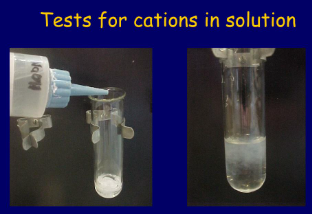
NaOH Test
NaOH supplies OH⁻ ions which form metal hydroxide precipitates.
NH₃ Test
Aqueous ammonia also supplies OH⁻ ions, but some precipitates dissolve due to complex formation.
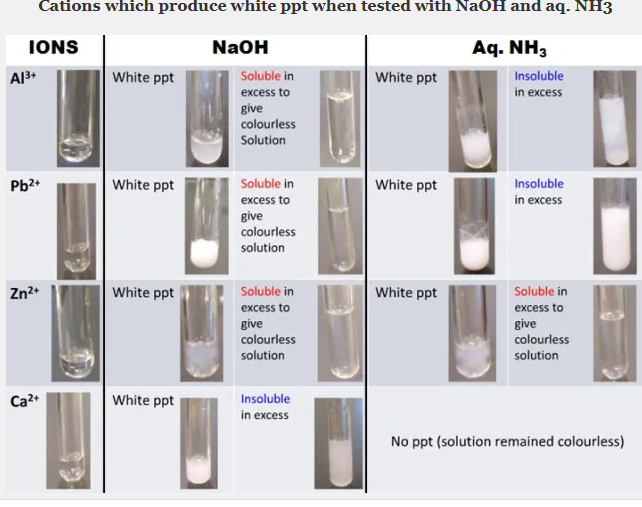
Precipitate Colour
Colour is a powerful clue: blue for Cu²⁺, green for Fe²⁺, brown for Fe³⁺ and white for Pb²⁺/Zn²⁺/Al³⁺.
2. Reagents Used in Cation Analysis
| Reagent | Main Function | WAEC Skill Tested |
|---|---|---|
| NaOH(aq) | Forms metal hydroxide precipitates | Colour and solubility in excess |
| NH₃(aq) | Forms hydroxides and complex ions | Distinguishes Zn²⁺, Cu²⁺ and Pb²⁺ |
| Dilute HCl | Forms insoluble chlorides with some ions | Pb²⁺ confirmation by white PbCl₂ |
| Dilute H₂SO₄ | Forms sulphates | Pb²⁺ confirmation by white PbSO₄ |
| Red litmus paper | Tests alkaline gas | NH₃ turns moist red litmus blue |
| Heat | Drives off ammonia from ammonium salts | NH₄⁺ confirmation |
3. WAEC Cation Analysis Master Table
| Cation | With NaOH in Drops | With Excess NaOH | With NH₃ in Drops | With Excess NH₃ | Inference |
|---|---|---|---|---|---|
| Pb²⁺ | White precipitate | Dissolves | White precipitate | Insoluble | Lead(II) ion present |
| Zn²⁺ | White precipitate | Dissolves | White precipitate | Dissolves | Zinc ion present |
| Al³⁺ | White gelatinous precipitate | Dissolves | White precipitate | Insoluble | Aluminium ion possible |
| Cu²⁺ | Blue precipitate | Insoluble | Light blue precipitate | Dissolves to deep blue solution | Copper(II) ion present |
| Fe²⁺ | Dirty green precipitate | Insoluble | Dirty green precipitate | Insoluble | Iron(II) ion present |
| Fe³⁺ | Reddish-brown precipitate | Insoluble | Reddish-brown precipitate | Insoluble | Iron(III) ion present |
| Ca²⁺ | White precipitate | Sparingly soluble/insoluble | No precipitate or slight white precipitate | No significant change | Calcium ion possible |
4. Practical Class: Identifying Pb²⁺ from Lead(II) Carbonate
Task
A white solid contains lead(II) carbonate. Add dilute HNO₃, warm gently and use the resulting solution for cation tests.
Procedure
- Put a little PbCO₃-containing sample in a test tube.
- Add dilute HNO₃ and warm gently.
- Observe effervescence.
- Use the clear acid solution for Pb²⁺ tests.
- Add NaOH in drops and then in excess.
- Add NH₃ in drops and then in excess to another portion.
- Add dilute H₂SO₄ to another portion.
- Add dilute HCl to another portion.
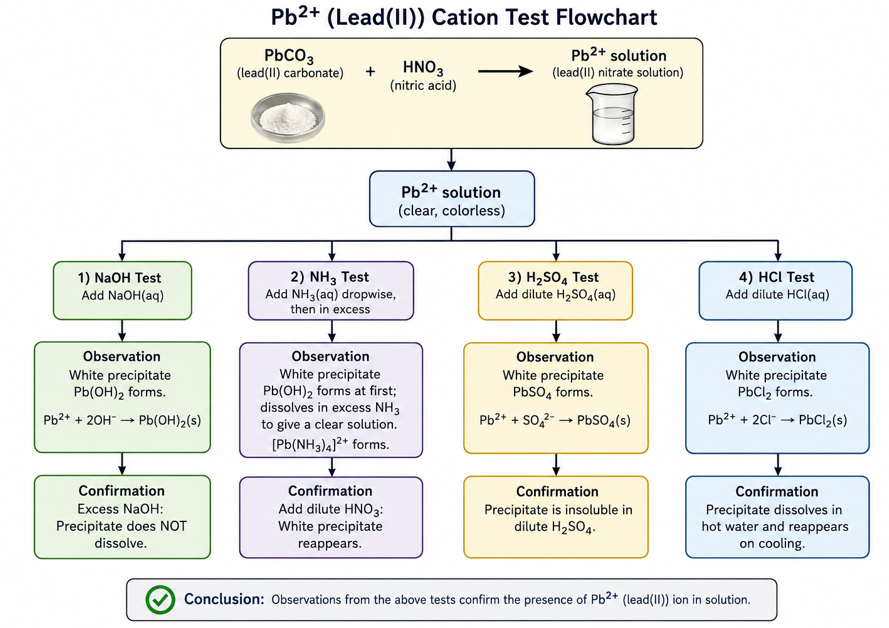
Show: Pb2+ + NaOH gives white precipitate soluble in excess; Pb2+ + NH3 gives white precipitate insoluble in excess.
Teacher
Students, once PbCO₃ reacts with dilute nitric acid, carbon dioxide escapes and soluble lead(II) nitrate remains in solution. That solution now contains Pb²⁺.
Expected Results
| Test | Observation | Inference |
|---|---|---|
| Solution + NaOH in drops | White precipitate formed | Pb²⁺, Al³⁺ or Zn²⁺ possible |
| Excess NaOH | Precipitate dissolves | Amphoteric ion present |
| Solution + NH₃ in drops | White precipitate formed | Pb²⁺, Al³⁺ or Zn²⁺ possible |
| Excess NH₃ | White precipitate remains insoluble | Pb²⁺ indicated |
| Solution + H₂SO₄ | White precipitate formed | Pb²⁺ confirmed as PbSO₄ |
| Solution + HCl | White precipitate formed | Pb²⁺ confirmed as PbCl₂ |
Equations
PbCO₃(s) + 2HNO₃(aq) → Pb(NO₃)₂(aq) + CO₂(g) + H₂O(l)
Pb²⁺(aq) + 2OH⁻(aq) → Pb(OH)₂(s)
Pb(OH)₂(s) + 2OH⁻(aq) → [Pb(OH)₄]²⁻(aq)
Pb²⁺(aq) + SO₄²⁻(aq) → PbSO₄(s)
Pb²⁺(aq) + 2Cl⁻(aq) → PbCl₂(s)
Student
Sir, why is Pb²⁺ confused with Al³⁺ sometimes?
Teacher
Because both may give white precipitate with NaOH which dissolves in excess NaOH. The difference is that Pb²⁺ can be confirmed with dilute H₂SO₄ to form white PbSO₄ and with dilute HCl to form white PbCl₂.
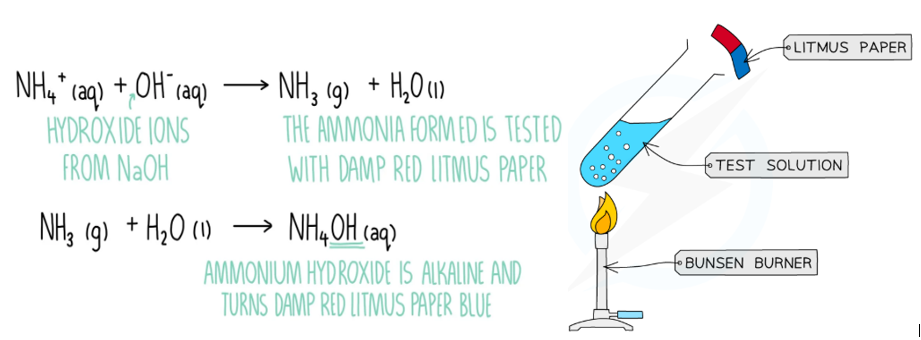
5. Practical Class: Testing for NH₄⁺
Although the supplied specimen may not contain ammonium salt, WAEC frequently tests ammonium ion knowledge. This is important for Question 3 practical theory.
Procedure
- Put a little ammonium salt solution in a test tube.
- Add NaOH(aq).
- Warm gently.
- Test the gas with moist red litmus paper.
Inference
NH₃ gas evolved; NH₄⁺ is present.
NH₄⁺(aq) + OH⁻(aq) → NH₃(g) + H₂O(l)
Teacher
Ammonia gas is alkaline. That is why it turns moist red litmus paper blue. The word “moist” is important because gases act better on damp litmus paper.
Student
Sir, can I write “ammonia produced” as observation?
Teacher
No. Write the observation first: “pungent gas evolved; moist red litmus paper turns blue.” Then infer ammonia or ammonium ion.
6. WAEC-Style Mixed Practical Task
Question
D is a colourless solution obtained after treating a white solid with dilute HNO₃. Carry out the following tests and complete the table.
- To the first portion, add NaOH in drops and then in excess.
- To the second portion, add NH₃ in drops and then in excess.
- To the third portion, add dilute H₂SO₄.
- To the fourth portion, add dilute HCl.
WAEC Marking Table
| Test | Observation | Inference |
|---|---|---|
| D + NaOH drops | White precipitate | Pb²⁺/Zn²⁺/Al³⁺ possible |
| Excess NaOH | Precipitate dissolves | Amphoteric ion |
| D + NH₃ drops | White precipitate | Pb²⁺/Al³⁺/Zn²⁺ possible |
| Excess NH₃ | Precipitate insoluble | Pb²⁺ indicated |
| D + H₂SO₄ | White precipitate | Pb²⁺ confirmed |
| D + HCl | White precipitate | Pb²⁺ confirmed |
Teacher Summary
This question follows a common WAEC pattern: first identify the possible ion using NaOH and NH₃, then confirm it using a more specific reagent.
7. Part 2 Exam-Ready Summary
Pb²⁺
White ppt with NaOH; soluble in excess NaOH. White ppt with NH₃; insoluble in excess. White ppt with H₂SO₄/HCl.
Zn²⁺
White ppt with NaOH and NH₃; dissolves in excess of both.
Cu²⁺
Blue ppt with NaOH; light blue ppt with NH₃ dissolves in excess to deep blue solution.
Fe²⁺
Dirty green precipitate, insoluble in excess.
Fe³⁺
Reddish-brown precipitate, insoluble in excess.
NH₄⁺
With NaOH and warming, pungent NH₃ gas turns moist red litmus blue.